
Views: 0 Author: Site Editor Publish Time: 2026-07-10 Origin: Site


How to Choose the Most Suitable Hospital Beds for Your Hospital?
Hospital beds come in many types, including electric and manual, with different cranks, and features such as CPR and weighing. So, when choosing hospital beds for your hospital, how do you select the most suitable and satisfactory features without spending too much money? Below is a selection guide from professional hospital bed supplier LONG MEDICAL for your reference. We've listed some frequently chosen scenarios; let's take a look!
1. Adult ICU Beds: Electric and Multifunctional are Key
ICU beds are platforms for rescuing and treating critically ill patients, requiring the highest level of functionality.
Drive Method: Must be electric. An electric system can precisely and smoothly adjust the bed's posture, which is crucial when precise positioning is required (such as ventilator-associated pneumonia prevention and postural drainage for patients with traumatic brain injury). Manual operation is time-consuming and laborious in emergencies and makes fine adjustments difficult.
Recommended Functions: At least five functions are required: backrest adjustment, legrest adjustment, overall height adjustment, forward tilting, and backward tilting. More advanced "seven-function" beds typically add left and right lateral turning (assisted turning, preventing pressure sores) and back-knee linkage (one-button knee flexion when sitting up, preventing the patient from sliding down).

Key Configurations:
One-button CPR (Cardiopulmonary Resuscitation) function: Allows for rapid bed leveling via electric or manual means in emergencies (including power outages), buying valuable time for resuscitation.
Backup battery: Ensures critical electric functions (such as position adjustment) remain operational during power outages.
Central brake wheels: Facilitate stable bed positioning and rapid movement.
Removable ABS headboard/tailboard: Facilitates cleaning and emergency resuscitation operations.
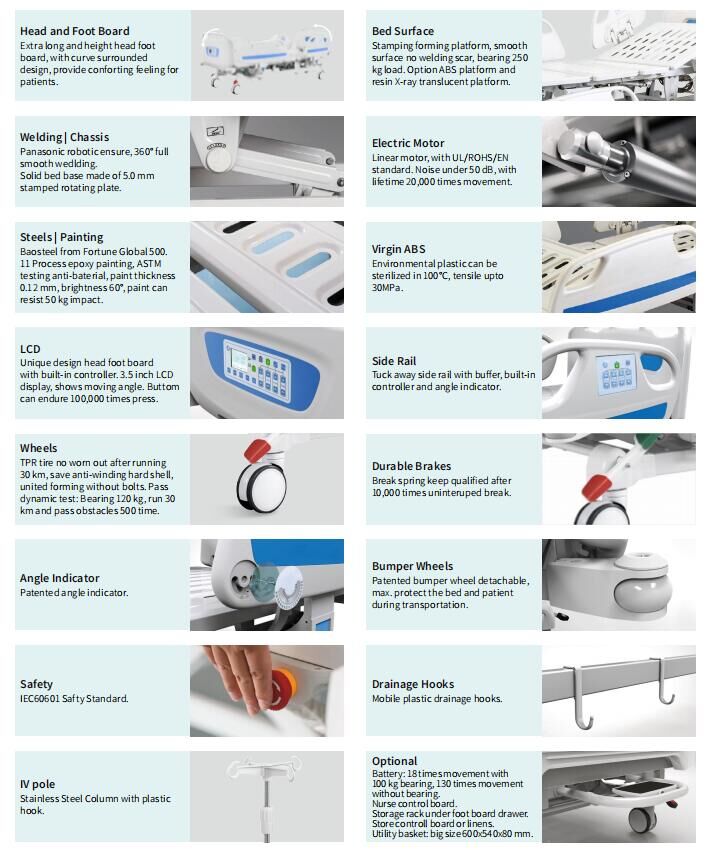
2. Adult Inpatient Beds: Manual operation is sufficient; economical and durable. Beds in general wards are primarily used for daily rest and basic care, requiring far less precision and frequency of position adjustments than those in the ICU.
Drive method: Manual (three-crank) is recommended. "Three-crank" refers to using three cranks to control backrest, legroom, and overall height adjustment respectively. Manual hospital beds are inexpensive to purchase, easy to maintain, and highly reliable, making them ideal for large-scale deployment in general wards.
Recommended Functions: Basic positioning adjustments are sufficient. For example, raising the back to facilitate eating or reading, and raising the legs to promote blood flow back to the lower limbs.
Key Features: Equipped with silent casters and brakes for easy movement and securing within the ward; featuring foldable guardrails and removable headboards and footboards to ensure patient safety and ease of cleaning.

3. Pediatric ICU Beds: Electric Beds Specifically Designed for Children
Children, especially infants, have different physiological structures and treatment needs than adults and cannot directly use adult ICU beds.
Specification Differences: Smaller, dedicated pediatric ICU beds must be selected to ensure patient safety and ease of care.
Functional Requirements: Functionally equivalent to adult ICU beds, they must be electric and also require overall height adjustment, tilting, and CPR functions to meet the complex needs of pediatric intensive care.


